 from Helsinki, Finland
Three Years of the Rohingya genocide – What does it tell us about the global community?
Three years ago, the Arakan conflict escalated into a genocide in the Rakhine state of Myanmar. Over 700,000 Rohingyas fled their homes and thousands were killed as the government of Myanmar systematically attacked Rohingya villages. Various international actors have tried to offer help: two legal cases have been submitted to international courts and one thorough fact-finding mission has been carried out. Still, little success has been accomplished as the conflict remains on-going and peace remains out of sight. A brief analyses of the Rohingya genocide highlights two great shortages within the current global legal order: a dependence on the influential political powers for help, and a lack of enforcement mechanisms within international law.
History of the conflict
The Rohingya Genocide is part of a protracted Arakan conflict between the government of Myanmar and the Rohingya minority group (UCDP 2020). It takes place in the Rakhine state (formerly the Arakan region) which is located along the Bay of Bengal and a border with Bangladesh. The particular area of the Rakhine is commonly known as an area inhabited by many Rohingyas, a predominantly Muslim ethnic minority of Myanmar. Historically, the originally Muslim area was a part of British India for decades before the independence of Burma in 1948 (officially known as Myanmar since 1989).
After the independence, various nationalist groups representing the Rohingya people have been fighting for equal rights and independence in the region. (UCDP, 2020) The conflict escalated into genocide in 2017, triggered by attacks on approximately 30 security posts by an armed group called Arakan Rohingya Salvation Army (ARSA). The government of Myanmar responded to these attacks by beginning to systematically kill and rape people and burn down villages in the Rakhine state. Additionally, other minority ethnic groups have been impacted as there are estimates of over 30,000 people being internally displaced.
Three years of Rohingya genocide
August 25th, 2020 marked the 3rd anniversary of the beginning of the Rohingya genocide in Myanmar. According to the Genocide Convention, a genocide refers to acts “with intent to destroy, in whole or in part, a national, ethnical, racial or religious group” (Genocide Convention, 1948). Genocidal acts can include acts such as killing people, causing serious harm, and imposing measures in order to prevent births within the group. Therefore, genocide is even more severe than ethnic cleansing as it includes an intention to destroy and not solely to remove or deport.
In the Rohingya’s genocide, the systematic state-led use of force clearly qualifies for some of the acts mentioned in the Genocide Convention. In fact, various international non-governmental organisation such as the Human Rights Watch have been raising awareness on the alleged genocide and its impact on the wider society. (Human Rights Watch, 2020) They have also been calling for international assistance and warning on the gravity of the consequences. Additionally, use of other forms of extreme violence have been reported and consequently over 700,00 people have fled to Bangladesh. (UNHCR, 2019) A major refugee camp known as Cox’s Bazar has formed on the Bangladeshi side of the common border with Myanmar (Amnesty International, 2020).
It is important to mention that the violence is not one-sided as armed groups representing the Rohingya population have also been carrying out extreme attacks. Amnesty International has reported that armed Rohingya groups had been attacking Hindu communities as a response to the violence against their own community (Amnesty International, 2018). This illustrates a continuum of the decade long conflict between the Hindu-dominated government and the Muslim Rohingya people. While the Rohingya-led acts cannot be justified either, the extent does not match the levels of crimes committed against the Rohingyas by the Myanmar government.
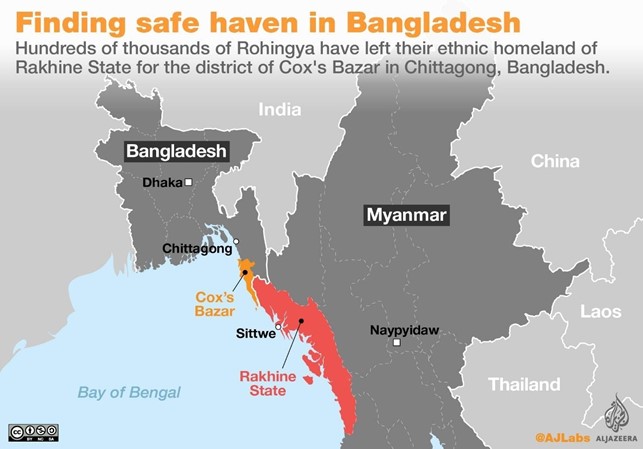
Al Jazeera, 2017
Lack of International action and political will
An awkward paradox has revealed itself during the Rohingya genocide. While the Genocide Convention has been ratified by 152 states and genocide is held as one of the absolute worst international crimes, the conflict is still on-going (Amnesty International, 2020). No efficient or sufficient interventions have taken place over the past three years. This is one of the most visible indicators of lack of political will and resources for timely action. Neither regional actors such as the ASEAN nor international actors such as the United Nations (UN) have managed to timely and decisively address the conflict.
After the mass atrocity crimes of the 1990s, the doctrine of Responsibility to Protect gained ground among the international community of states (Global Centre for the Responsibility to Protect, 2005). According to it, when a state fails to protect its people, the international community has the responsibility to react. This responsibility is often understood to take some form of international intervention to protect the group under attack. Additionally, international interventions are often understood to include military dimensions and therefore an approval by the UN Security Council is considered essential. As ideal as this doctrine sounds for the Rohingya case, it has not been helpful. The main, if not the only, explanation is the lack of political will of the most powerful states to intervene. The UN Security Council has released a ‘presidential statement’ calling for an end of violence in Myanmar but not one concrete, binding resolution has been done.
As international interventions ‘need’ to be approved by a UN Security Council resolution, the members of the Council can both initiate or restraining an intervention. In other words, if the members of the Security Council have an interest in upholding the conflict, an intervention is unlikely to happen.
Initiative by the UNHCR
Thankfully, not every international organ has sat aside twiddling thumbs. In fact, the United Nations Human Rights Committee (UNHRC) reacted even before the conflict escalation and launched an independent international fact-finding mission on Myanmar in 2017 (OHCHR, 2017). The mission lasted for one and a half years and concluded in 2019 with a lengthy report on the appalling findings.
The UNHRC put forward concrete evidence on various genocidal acts, crimes against humanity and other human rights violations that had been committed in the Rakhine state since the beginning of the genocide. It stressed that 600,000 Rohingyas still remain in imminent danger and demanded better responses by the international community. However, the UNHRC alone cannot do much else, which illustrates the power dynamics not just between the various UN organs but also the UN and its member states. In particular, the dominance of the Security Council embedded in the structures during the creation of the UN is striking.
International Criminal Court takes on the issue
In 2019, the Republic of Myanmar was sued in two major international courts: the International Criminal Court and the International Court of Justice. The International Criminal Court (ICC) addressed a case submitted by Bangladesh which has been hosting around million refugees from Myanmar (ICC, 2019a). Bangladesh accused Myanmar of committing crimes against humanity including deportation and persecution. Followingly, the ICC Prosecutor Fatou Bensouda requested judicial authorisation for starting an investigation on the alleged crimes committed in the Rakhine state (ICC, 2019b). Alleged crimes against humanity were noted to include deportation of at least 700,000 Rohingyas through a range of coercive acts. This report also notes that hundreds of thousands of Rohingya victims have experienced great suffering or serious injury during the genocide.
The challenge with the ICC case, however, is the lack of jurisdiction over Myanmar. As the ICC was established by the Rome Statute (1998), Myanmar, which is not party to the statute, can claim the ICC has no jurisdiction over its territory (ICC, 2011). The only way for the Court to go around this and gain jurisdiction would be if the UN Security Council referred to it. This, as mentioned above, is not likely in this situation as the Security Council has shown little interest in the conflict in general. Yet, the symbolic meaning of the international legal case for the Rohingya population is significant. It signals that the Rohingyas have not been forgotten and that some international actors are trying to help them. Additionally, the Court has been listening to the victim testimonies which has given them recognition, raised awareness, and drawn some attention to the conflict.
Historical case at the World Court
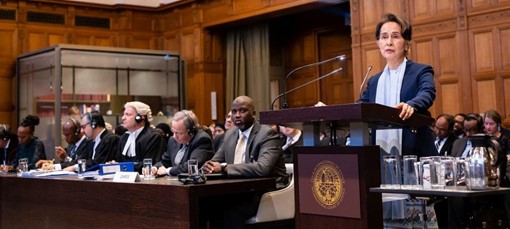
During the same year, the Republic of the Gambia submitted a case to the International Court of Justice (ICJ, 2020). The Gambia invoked the Genocide Convention and accused Myanmar of committing genocidal acts against the Rohingya minority. They demanded for proceedings against Myanmar and aimed to indicate provisional measures. It is noteworthy to mention that leading the Myanmar defence in the ICJ was Aung San Suu Kyi, the 1991 Nobel Peace Prize laureate and the current State Counsellor of Myanmar. It is striking that during the Court’s hearings, she managed to defend Myanmar’s position as nonguilty without using the word genocide once (Opinio Juris, 2019). The symbolic meaning of avoiding the concept of genocide is to avoid giving any power to the concept. Avoiding the use of the concept of genocide is a known diplomatic tactic used to postpone requirements for timely action (Power, 2001).
While it might take the court years to reach a concluding decision, the provisional measures are aimed at ordering a state to stop behaving in a harmful manner prior to the decision. In this case, they are aimed at slowing down the genocide and preferably to fully end it, of course. The provisional measures indicated by the ICJ do not automatically imply compliance, which in this case has been illustrated by Myanmar’s non-existent response (ICJ, 2020). Various other cases in history have also shown that provisional measures are not efficient due to the lack of functional legal enforcement bodies and mechanisms. In fact, the possibility of non-compliance to international laws and sanctions is one of the main shortcomings of our current global legal order.
UN News, 2019
Advances to Global Legal Order
This specific ICJ case is significant as it has noteworthy implications for the wider global legal order. Firstly, the ICJ decision legally defines the conflict a genocide, which can be used against Myanmar in the future. The legal naming is also important in pressuring the UN for concrete, timely action, especially if new evidence on genocidal acts arises. Additionally, it strengthens the international role of the Genocide Convention and reminds that it is still applicable today.
Furthermore, the case addresses a continuing legal debate on extraterritoriality which refers to states’ capability to act on issues taking place outside of their territory. It is the first case in history where a state from a different continent, without being directly affected by the conflict, brings an issue to the ICJ (International Bar Association, 2019). For this, the former Justice Minister of Gambia, Abubacarr Tambadou, has recently been named as one of the 100 most influential people of 2020 (Power, 2020).
Therefore, by addressing the case, the ICJ alters international law by enforcing the status of erga omnes and the extraterritorial responsibility of states within the global jurisdiction. In a similar fashion, the extraterritorial dimension strengthens the global status of the responsibility to protect doctrine. Finally, a reminder that it was the Gambia that brought the case to the ICJ, backed various non-governmental organisations. This is interesting as The Gambia is a non-Western state taking action with non-state agents regarding international law. Thus, there is a brief silver lining in the international legal cases.
Failure of the global community?
However, over the past 3 years, the global community has not succeeded in constraining Myanmar’s violent and illegal action. The UN Security Council has not managed to adopt one single binding resolution on Arakan conflict. In addition, no remarkable sanctions or other forms of efficient international pressure have been raised against Myanmar. The government of Myanmar keeps ignoring the issue and continuously commits violent and genocidal acts against the Rohingya minority. The non-compliance is evident. In other words, the international society has not managed to pressure Myanmar into complying with the global legal and political norms. Additionally, the Rohingyas trapped in the refugee camp are extremely vulnerable in facing the current COVID-19 pandemic (Amnesty International, 2020).
This highlights two considerable flaws of the global order today. The first is the dependence on the great political powers for initiative, and the second is the lack of credible and operational enforcement mechanisms. This raises the question if global norms can ever truly function globally as little justice can follow responsibility and accountability that are non-existent. Still today, there is little to no peace for the Rohingyas and it remains to be seen whether safety or justice are ever going to be served.
Bibliography (A-I)
Al Jazeera (2017). Rohingya crisis explained in maps. (online) https://www.aljazeera.com/indepth/interactive/2017/09/rohingya-crisis-explained-maps-170910140906580.html (Accessed 16 September 2020)
Amnesty International (2018). Myanmar: New evidence reveals Rohingya armed group massacred scores in Rakhine State. (online) https://www.amnesty.org/en/latest/news/2018/05/myanmar-new-evidence-reveals-rohingya-armed-group-massacred-scores-in-rakhine-state/ (Accessed 16 September 2020)
Amnesty International (2020a). Let us speak for our rights: Human rights situation of Rohingya refugees in Bangladesh. (online) https://www.amnesty.org/download/Documents/ASA1328842020ENGLISH.PDF (Accessed 17 September 2020)
Amnesty International (2020b). Myanmar: Indiscriminate airstrikes kill civilians as Rakhine conflict worsens. (online) https://www.amnesty.org/en/latest/news/2020/07/myanmar-indiscriminate-airstrikes-kill-civilians-rakhine/ (Accessed 16 September 2020)
ASEAN Association of Southeast Asian Nations, 2020, https://asean.org/ (Accessed 16 September 2020)
Convention on the Prevention and Punishment of the Crime of Genocide (1948). (online) Available: https://www.ohchr.org/EN/ProfessionalInterest/Pages/CrimeOfGenocide.aspx (Accessed 16 September 2020)
Global Centre for the Responsibility to Protect (2005). World Summit Outcome A/60/L.1. (online) Available: https://www.globalr2p.org/what-is-r2p/ (Accessed 15 September 2020)
Human Rights Watch (2020). Myanmar: Rohingya Await Justice, Safe Return 3 Years On. (online) https://www.hrw.org/news/2020/08/24/myanmar-rohingya-await-justice-safe-return-3-years (Accessed 17 September 2020)
International Bar Association (2019). The Gambia brings historic genocide case against Myanmar. (online) https://www.ibanet.org/Article/NewDetail.aspx?ArticleUid=02a82017-63c8-4c20-a9eb-bc9dbfcf26bc (Accessed 16 September 2020)
International Court of Justice (2020). Application of the Convention on the Prevention and Punishment of the Crime of Genocide (The Gambia v. Myanmar). (online) https://www.icj-cij.org/en/case/178 (Accessed 16 September 2020)
International Criminal Court (2011). Rome Statute of the International Criminal Court. (online) https://www.icc-cpi.int/resource-library/Documents/RS-Eng.pdf (Accessed 16 September 2020)
International Criminal Court (2019a). Bangladesh/Myanmar. (online) https://www.icc-cpi.int/bangladesh-myanmar (Accessed 16 September 2020)
International Criminal Court (2019b). ICC Prosecutor, Fatou Bensouda, requests judicial authorisation to commence an investigation into the situation in Bangladesh/Myanmar. (online) https://www.icc-cpi.int/Pages/item.aspx?name=pr1465 (Accessed 16 September 2020)
International Criminal Court (2020). How the court works?. (online) https://www.icc-cpi.int/about/how-the-court-works (Accessed 16 September 2020)
Bibliography (O-Z)
OHCHR (2020). Independent International Fact-Finding Mission on Myanmar. (online) https://www.ohchr.org/en/hrbodies/hrc/myanmarffm/pages/index.aspx (Accessed 14 September 2020)
Opinio Juris (2019). The Gambia v Myanmar: Day 2 of the Provisional Measures hearing at the International Court of Justice. (online) https://opiniojuris.org/2019/12/12/the-gambia-v-myanmar-day-2-of-the-provisional-measures-hearing-at-the-international-court-of-justice/
Opinio Juris (2020). ICJ Order on Provisional Measures: The Gambia v Myanmar. (online) https://opiniojuris.org/2020/01/24/icj-order-on-provisional-measures-the-gambia-v-myanmar/
Samantha Power (2020). The 100 Most Influential People 2020 – Abubacarr Tambadou. The Time Magazine. (online) https://time.com/collection/100-most-influential-people-2020/5888167/abubacarr-tambadou/ (Accessed 23.09.2020)
Samantha Power (2001). Bystanders to Genocide. 288 Atlantic Monthly 84. (online) https://www1.essex.ac.uk/ARMEDCON/story_id/BystandersToGenocideRawanda.pdf
Simon Adams (2020). Rohingya Symposium: The UN Security Council, the Rohingya Genocide and the Future of International Justice. Opinio Juris. (online) https://opiniojuris.org/2020/08/27/rohingya-symposium-the-un-security-council-the-rohingya-genocide-and-the-future-of-international-justice/
UN News (2019). Aung San Suu Kyi defends Myanmar from accusations of genocide, at top UN court. (online) https://news.un.org/en/story/2019/12/1053221 (Accessed: 17 September 2020)
UNHCR (2019). Rohingya emergency. (online) https://www.unhcr.org/rohingya-emergency.html (Accessed 15 September 2020)
Uppsala Conflict Data Program (UCDP 2020). Myanmar (Burma): Arakan. (online) https://ucdp.uu.se/conflict/223 (Accessed 17 September 2020)
Autore dell’articolo*: Sini M. Kuutamo, expert in Human Rights and International Law of the think tank Trinità dei Monti. BA (Hons) in Politics and International Relations with French at the University of Kent and current Master’s studies in Global Governance Law at the University of Helsinki student.
***
Editor’s Note – Think Tank Trinità dei Monti
As always, we publish our articles to encourage debates, and to spread knowledge and original and alternative points of view.
* The contents and the opinions of this article belong to the author(s) of this article only.
Nota della redazione del Think Tank Trinità dei Monti
Come sempre pubblichiamo i nostri lavori per stimolare altre riflessioni, che possano portare ad integrazioni e approfondimenti.
* I contenuti e le valutazioni dell’intervento sono di esclusiva responsabilità dell’autore.